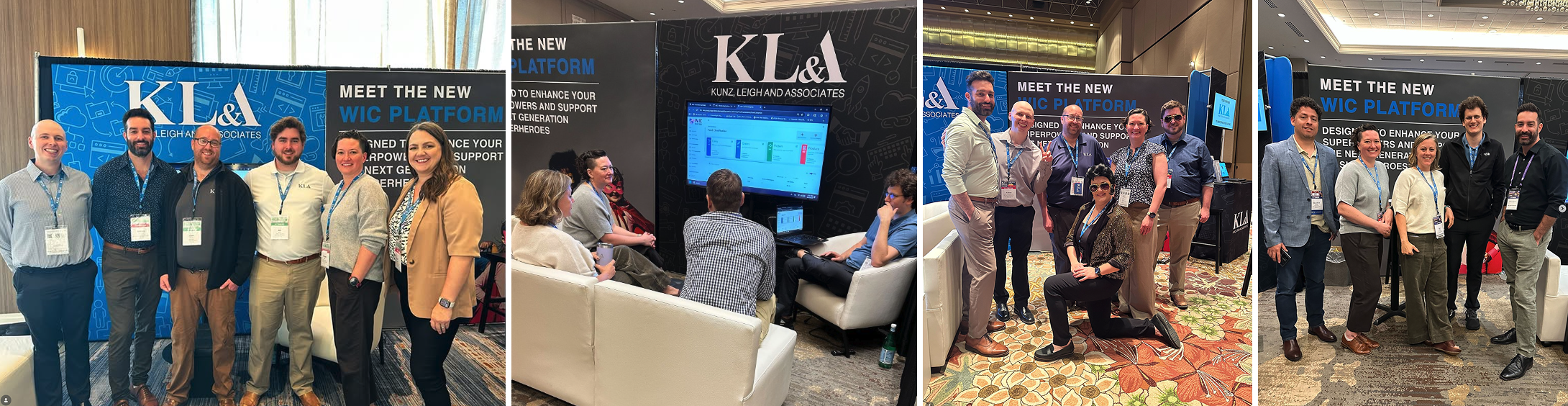
KL&A had spent 30 years delivering custom government software, building exactly what each client specified. When they decided to build their first commercial product, a modern WIC Management Information System, they created something else they'd never had before: a Product Manager role.
I stepped into that undefined position in late 2023 and spent two years navigating a tension I didn't fully anticipate. To build a great product, I needed to be close to the work: conducting discovery, designing solutions, and validating with users. But to build a product organization, I needed to step back from the work: creating infrastructure, enabling my team, and shifting a 30-year-old custom development culture toward product thinking. Doing both simultaneously, with limited resources and no blueprint, was the real challenge this case study is about.
The result: a federal research-validated product architecture, working demonstrations at five national conferences, zero team attrition over two years, and a clearer picture of what product management can look like inside a custom development company.
Why This Moment, Why This Product
The Women, Infants, and Children program is deceptively complex. Most people think of it as a client benefit program, but it operates across three interconnected domains: participant case management, vendor authorization, and food package administration. All three have to reconcile with each other in real time. A change to an approved food item ripples across vendor eligibility, participant benefits, and state compliance reporting simultaneously. It is a surprisingly complex system, and the software supporting it hadn't kept pace.
Many state WIC agencies were running on legacy platforms over 20 years old. These systems were so rigid that routine regulatory updates required full development cycles, sometimes taking months. Staff had adapted by building manual workarounds across disconnected tools, absorbing the complexity that software should have handled for them.
KL&A saw an opportunity. Federal grants for modernization were active, states would soon need to spend that money, and no modern commercial WIC MIS existed that could serve multiple states without heavy customization. They decided to build one from scratch: the company's first commercial product after 30 years of custom development.
Early validation came quickly, and from an unexpected source. At the National WIC Association conference in Portland, our booth happened to be next to a third-party compliance investigator who worked directly with state agencies on vendor investigations. He walked through what we had built, asked sharp questions, and then said something that stuck: wouldn't it be something if he could log into a system like this out in the field and run his investigation directly? He wasn't a potential customer. He had no reason to flatter us. He was just describing, unprompted, a capability our product could naturally support. It was the kind of validation you can't manufacture.
A few months later, a $14.9 million federal grant was awarded [1] to research modernization pathways for WIC systems nationally. We hadn't known it was coming. When the initial findings were published [2], they described the ideal modern WIC platform as participant-first, human-centered, modular, and licensable. Those were the exact principles we had already been building around. We hadn't found product-market fit by chasing a funding signal. We had found it by listening carefully to the people closest to the problem.
Defining the Role by Doing the Work
I joined the WIC product team in November 2022 as a staff engineer, a year before I stepped into the Product Manager role. From the start, I was answering questions KL&A had never needed to answer before. What does product management look like when you're building for multiple states instead of a single client? How do you balance discovery with delivery in a regulated industry? What should I own, and what should the team own?
I answered those questions by doing the work and adjusting as I learned. That meant leading through collaboration rather than direction, gathering input before major decisions, and creating space for engineers at every level to speak up, push back, and take ownership. We were building a complex 0-to-1 product with limited resources in a regulated industry. I needed the team to think, not just execute.
It worked. Within six months, the team had developed a shared instinct for the work. We understood how each person thought, where their strengths naturally pulled them, and what they needed from one another. By mid-2024, my tech lead had grown into full ownership of the engineering side, consulting me on complex problems but driving the direction himself. I had become more of a subject-matter expert than an engineering leader and that felt like the right outcome. Over two years of building through ambiguity and shifting priorities, we had zero attrition. In my experience, that doesn't happen without psychological safety as a genuine foundation and by becoming human-centered internally, too.
But the role also presented a tension I didn't fully anticipate. To build a great product, I needed to stay close to the work: conducting discovery, designing solutions, and validating with users. To build a product organization, I needed to step back: create infrastructure, enable the team, and shift a custom development culture toward product thinking. I stayed in the doing far longer than I should have. That tension was never fully resolved. It just changed shape as the team grew, and it shaped almost every decision I made.
Learning to Listen at Scale
Building a commercial product required a fundamentally different approach than KL&A's traditional requirements-driven engagements with contracted clients. Part of defining the PM role was establishing what discovery should look like in this new context. After the conference in Portland, we realized we needed design thinking and a product mindset to serve multiple states, each implementing the federal program slightly differently. This changed our discovery process.
September 27-29, 2023 | Portland, OR
2023 NWA WIC Technology, Innovation, and Vendor Management Conference
Showcased vendor management including vendor authorization workflow and compliance.
April 7-10, 2024 | Chicago, IL
2024 NWA Annual Education and Training Conference
Showcased food management including food package creation and food package tailoring demo.
Showcased the participant portal including communication preferences, health journey, achievements, and breastfeeding support via in-app messaging.
April 22-25, 2025 | Las Vegas, NV
2025 NWA Annual Education and Training Conference
Showcased the participant pre-certification workflow and intake process.
September 3-5, 2025 | Minneapolis, MN
2025 NWA Technology, Innovation, and Vendor Management Conference
Showcased agency security and summaries, risk and referral management, and inventory management.
I worked consistently with our internal SME in frequent meetings to understand regulations and current user workflows. We conducted focus group sessions with staff members across three states to understand state-level variations. We gathered feedback from 5 National WIC Association conferences between August 2023 and September 2025, showcasing new features at each as development milestones. Over time this created a rhythm: discover, design, develop, repeat. Features moved quickly because each one was grounded in real insight. Over 2+ years, I led 40+ discovery sessions incorporating insights from conferences and focus groups across more than 30 distinct feature sets.
Early in discovery, a clear pattern emerged: legacy systems with hard-coded values required full development cycles for regulatory updates, sometimes taking months. States needed flexibility to stay compliant without waiting for developers. This insight shaped our approach: we prioritized user-configurable features throughout the platform, from forms to workflows to validation rules. We also discovered that many states still relied on manual paper processes, such as breast pump loans or formula inventory, so we built configurable workflow automation to digitize these processes.
This problem-solving approach proved itself in April 2024 when the USDA announced the WIC Final Food Rule at the Chicago conference [3]. States had 24 months to implement. Because we designed food packages to be user-configurable from the start, we validated the Final Food Rule updates against our system at the conference itself, demonstrating that our approach eliminated the lengthy release cycles that plagued legacy systems. This design thinking became one of our key competitive differentiators.
Designing for People, Not Just Compliance
WIC software had long been built around administrative compliance. We set out to build around people instead, and that distinction shaped every design decision we made. The most visible expression of this was our health journey, a compassionate timeline surfacing health insights, education, and support for participants. But the philosophy permeated the entire system, representing a shift from administrative case management to genuine supportive engagement.
I applied Jakob's usability heuristics [4] throughout. Information architecture was a particular focus: I wanted the system to follow users' mental models rather than the underlying data structure, exposing functionality in a logical hierarchy with the most frequently used features within easy reach. I leaned into recognition over recall to reduce cognitive overload, maintained consistency across the design language, and built in both personalization at the user level and customization at the state level. Validation, error recovery, and microcopy were treated as core design work, not afterthoughts, written in plain language and aligned with a consistent brand voice.
As the team grew, I recognized that the PM role wasn't only about making good product decisions. It was about building the foundation that would enable the team to make good decisions without me in the room. I developed a reusable design operations framework: shared defaults for research, handoff, delegation, and writing. It was built to enable consistent delivery, faster onboarding, and higher velocity as the team scaled. Building it was also where the tension between doing and enabling was sharpest. I was doing significant design work while simultaneously building the systems that would eventually let me stop doing it myself.
That tension showed up at the feature level, too. Risk management began as simple forms in early mockups. As we kept validating with our subject matter expert and understood the true regulatory complexity, we evolved the design into a step-based wizard that progressively guided users through each component. The final design looked nothing like the first. That only happened because we kept validating rather than assuming we understood the requirements upfront, and it ensured we met complex regulations while maintaining usability.
Where We Chose to Bet
The original plan was to build vendor management, then food management, and then the clinic. Discovery at the Portland and Chicago conferences revealed a gap. The concept of a participant-first program was strongly held but not reflected in the software that supported it. I advocated pivoting to an external-facing participant portal next. It was a strategic detour, and not an obvious one in a company built around delivering only what clients specified.
My aim was to balance risk and speed. We sequenced our engineering investment deliberately, building full infrastructure where requirements were well understood and validating new concepts quickly before committing to full implementation. This let us move fast without overbuilding in the wrong direction.
The participant portal was a success. The response in Baltimore confirmed we had identified the right direction. The participant-first philosophy became our North Star.
We invested in configurability as a strategic choice. Rather than custom-coding per state, we selectively focused on where states clearly had divergent approaches, such as workflow processes, form content in specific areas, and algorithms. This meant we could build a more maintainable, scalable product tailored to their programs with less engineering work. Where workflows and user needs were consistent, we maintained standard implementations. This architectural choice enabled true COTS (commerical-off-the-shelf) scalability. It meant we could spend our engineering investment where it mattered most: on the features that made the product worth buying.
Validation & Outcomes
Over two years, we validated our product direction through five national conference demonstrations, direct stakeholder engagement, and alignment with external research. Several states expressed strong commercial interest, though translating that interest into contracts required navigating the realities of government procurement cycles. The $14.9 million federal grant research findings [2] directly validated our product approach: participant-first, human-centered, modular, and licensable architecture aligned precisely with their recommendations for the modern WIC program.
We delivered working demonstrations of vendor management, food management, and participant portal modules, showcasing critical workflows including vendor authorization, food package creation, and participant intake. The system supported state agencies with multiple local clinics. The comprehensive design system and operational framework focused on consistent delivery as the team scaled. We established the infrastructure foundation even as we continued building toward full certification workflows.
The team grew from 4 to 10 over two years, with 2 promotions and 2 progressions into engineering leadership roles, while maintaining high code and design quality. This work taught me two critical lessons. First, championing product thinking, configurability, scalability, and architecture in a custom development culture required constant education and reinforcement. The biggest challenge wasn't technical. It was shifting the mindset from "build what this client needs" to "build what enables all clients to succeed." Second, regulatory complexity reveals itself iteratively. You can't front-load all compliance discovery. Building continuous validation loops with SMEs and designing for configurability from the start proved essential to maintaining both compliance and usability.
Regulatory complexity reveals itself iteratively. You can't front-load all compliance discovery.
There is a third lesson that took longer to name. I stayed in the doing far longer than I should have. I was conducting discovery, leading design work, managing the team, and building operational infrastructure simultaneously, and for a long time, that felt like what the role required. In some ways, it was. But it also meant that when the team needed me to step back and operate at a truly strategic level, I didn't always have the bandwidth to get there. The tension between building the product and building the organization never fully resolved. That is what I would most want to do differently, and what I now understand most clearly.
The biggest challenge wasn't technical. It was shifting the mindset from 'build what this client needs' to 'build what enables all clients to succeed.'
These lessons shaped my understanding of what product management fundamentally is. In hindsight, I would have invested in operational infrastructure, design system, process templates, and onboarding resources even earlier, before the team scaled. I would also formalize the product mindset in writing during onboarding, rather than reinforcing it only verbally throughout the project lifecycle. By the end, I understood that the PM role in a 0-to-1 environment is about holding the vision while building the right structure: the systems, documentation, and frameworks that empower the team to take ownership and execute independently.
The PM role in a 0-to-1 environment is about holding the vision while building the right structure: the systems, documentation, and frameworks that empower the team to take ownership and execute independently.
That understanding doesn't belong to this product or this company. It's the thing I'd carry into any 0-to-1 environment and build from, earlier.
References
[1] National WIC Association, "NWA Receives USDA Funding to Modernize WIC MIS," September 2024. nwica.org
[2] National WIC Association and Nava PBC, "Modernizing WIC's MIS: Findings from Year One of Research," 2025. nwica.org
[3] USDA Food and Nutrition Service, "Biden-Harris Administration Announces Finalized Science-Driven Updates to Foods Provided Through WIC," April 9, 2024. usda.gov
[4] Jakob Nielsen, "10 Usability Heuristics for User Interface Design," Nielsen Norman Group, 1994, updated 2020. nngroup.com